
The AMG CLE 646 versus The Mustang GTD: A Tale of Two V8 Super-Coupes in 2026
Mercedes-AMG’s most exclusive creation, the Spezialanfertigung CLE 646, has finally entered production, signaling a powerful revival of the brand’s cherished V8 lineage. As an ultra-limited production model, featuring an all-new V8 engine, the CLE 646 stands as a testament to AMG’s engineering prowess, costing a rumored one million dollars. It represents the pinnacle of the brand’s performance coupe offerings. Yet, in the realm of automotive excess, this German beast faces a potent adversary from the American muscle car scene: the Ford Mustang GTD. The GTD offers comparable exclusivity but costs significantly less, while boasting even more raw power, creating a high-stakes rivalry that captivates automotive enthusiasts worldwide.
Mercedes-AMG’s dramatic return to the traditional V8 engine configuration marks a pivotal moment. In an era where many high-performance marques have embraced hybrid and electric architectures, the CLE 646’s introduction satisfies those who believe true power resides in naturally aspirated combustion. For years, enthusiasts yearned for a return to the raw, visceral driving experience that defined the AMG Black Series. The CLE 646 arrives as a spiritual successor, offering a compelling blend of luxury and extreme performance. Its price tag places it in the stratosphere of collectible cars, far removed from the everyman’s dream of a Mustang. However, the GTD proves that high-end, race-inspired engineering does not always require an exclusive, multi-million-dollar price tag.
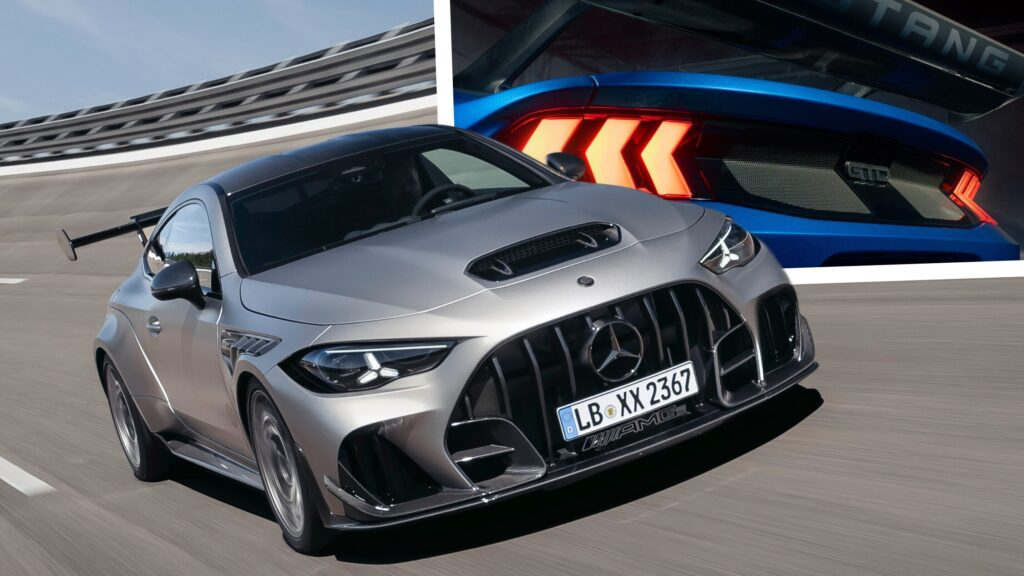
The automotive landscape of 2026 is defined by this juxtaposition of opulence and aggression. Mercedes-AMG has positioned the CLE 646 as the ultimate statement piece, a collector’s item that will appreciate over time. Conversely, the Mustang GTD represents American engineering at its most ambitious. Developed for circuit dominance, the GTD blurs the lines between a road-legal car and a pure racing machine. But which of these behemoths truly stands out in 2026? Which offers the most engaging experience, and which offers the best performance-per-dollar ratio, even if “best” is subjective in this rarified atmosphere?
In this comprehensive evaluation, we dissect the technical specifications, design philosophies, and performance metrics of both the AMG CLE 646 and the Ford Mustang GTD. We explore the engineering choices that define these two titans, the exclusivity that justifies their prices, and the sensory experiences that distinguish them. By understanding what makes each car special, enthusiasts and potential buyers can better appreciate the unique position each occupies in the 2026 hypercar landscape.
The Foundation: From Luxury Coupe to Supercar Statement
Both the AMG CLE 646 and the Mustang GTD begin their lives on the same production line as much more attainable vehicles. The Mercedes-AMG is based on the CLE coupe, which generally starts in the low $60,000 range. In stark contrast, the Ford Mustang GTD is derived from a Mustang Dark Horse, which begins at a price point only slightly higher than its base model siblings. However, the similarities stop abruptly there. Both brands are deliberately reserved when discussing the final prices of these hyper-exclusive models. While the CLE 646 is widely reported to command a sticker price approaching one million dollars, the Mustang GTD is not exactly a budget option either. A standard GTD will cost around $327,000 before options and taxes, placing it in a luxury performance bracket that is well beyond the reach of average consumers.
This level of pricing demands extraordinary exclusivity. Ford is capping the total production of the Mustang GTD at 1,700 units, while AMG is limiting the production of the CLE 646 to just 30 vehicles worldwide. This scarcity is encapsulated in the awkward German nomenclature for the AMG: Spezialanfertigung, which translates to “custom-made.” All 30 of these AMG coupes have already been sold, making them unobtainable for the typical buyer. However, potential buyers may still have the chance to acquire a Mustang GTD, though the waiting list is long, and allocation is often discretionary rather than first-come, first-served.
In a practical sense, a buyer looking for extreme performance without the million-dollar price tag faces an unenviable choice. Does one prioritize the engineering sophistication and prestige of the AMG, accepting the premium for the badge and exclusivity, or does one opt for the raw, track-focused power of the Mustang GTD, enjoying a slight edge in performance for a significantly lower investment? Both cars require substantial financing, but the financing rates for luxury vehicles of this caliber are often prohibitive for average buyers, forcing them into premium financial products or expensive luxury auto loans.
Visual Warfare: Aggression Meets Artistry
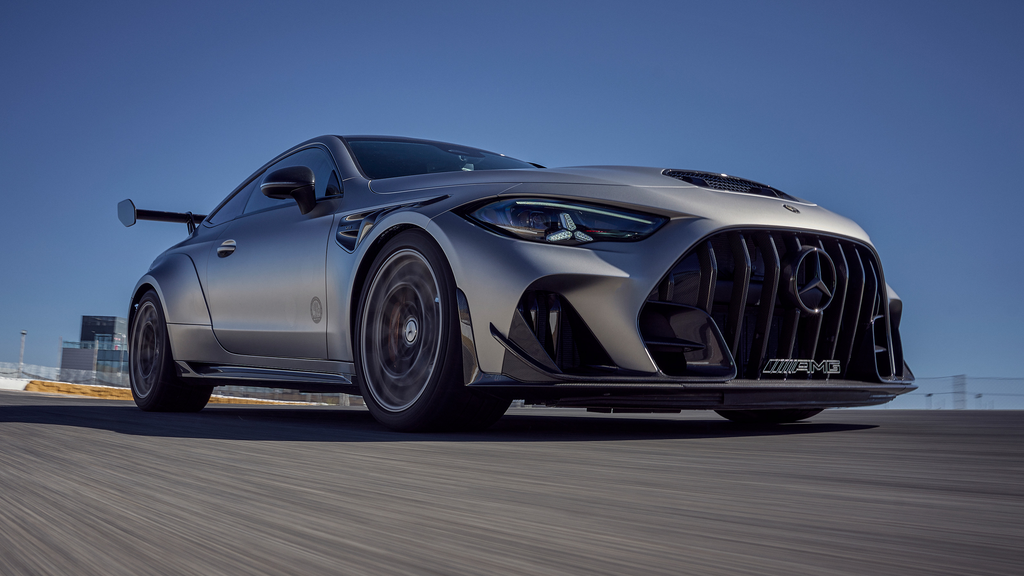
From a visual standpoint, the AMG CLE 646 exudes an aura of pure aggression. AMG’s design language has evolved significantly in recent years, moving away from subtle elegance to bold, muscular statements. The CLE 646 amplifies this trend by featuring significantly widened carbon fiber front fenders, complete with sawtooth vents that echo the design of the Porsche 911 GT3. The massive front intake resembles the mouth of a predator, designed to pull in air for the monstrous engine and cooling systems. The hood features a functional air scoop that draws heat away from the engine bay, while the stick-on rear fenders, made from carbon fiber, accommodate wider, higher-grip tires. A colossal rear wing dominates the rear profile, designed to generate downforce that maximizes grip at high speeds. The front diffuser and rear wing are adjustable, allowing the driver to fine-tune the aerodynamic balance for optimal track performance. In its most aggressive aerodynamic setting, the AMG can generate up to 551 lbs (250 kg) of downforce.
The AMG CLE 646 possesses an aggressive stance that is almost unmatched in the automotive world. However, catching sight of a Ford Mustang GTD in full warpaint challenges this perception. While a standard GTD is relatively restrained, featuring only a small fixed rear spoiler, the optional Performance Pack transforms the Mustang into an even more aggressive machine. This pack, which pushes the price beyond $400,000, includes a massive rear wing with an F1-style Drag Reduction System (DRS), front dive planes, a larger splitter, and underbody aero flaps. With these additions, the Mustang GTD generates a staggering 1,951 lbs (885 kg) of downforce at 180 mph (290 km/h), far exceeding the AMG’s output.
The GTD’s aggressive stance is further emphasized by its massive tires. It utilizes a 325 mm front and 345 mm rear tire configuration, significantly wider than the AMG’s 305/335 pairing. This girth advantage is not the Mustang’s only physical superiority. Despite riding on a 6-inch (155 mm) shorter wheelbase, the GTD is approximately 3.5 inches (90 mm) broader than the AMG. This vehicle is as wide as a large SUV, and with a weight of 4,343 lbs (1,970 kg), it is nearing SUV-level mass. In contrast, the AMG, at 4,780 lbs (2,168 kg), is not exactly a featherweight either, though AMG claims to have shaved 375 lbs (170 kg) from the stock CLE’s weight.
What this means for buyers is a choice between aesthetic drama and functional aggression. The AMG offers a level of sculpted beauty that few cars can match, whereas the GTD looks like it was bred directly from the race track. The engineering decisions behind the aero package determine how each car handles the pavement, with the GTD prioritizing downforce and grip above all else.
Heart of the Beast: Power, Performance, and Purity
The most significant news regarding the AMG CLE 646 isn’t the car itself but what resides under the hood. This represents the first appearance of the new M177 Evo engine, a flat-plane crank V8 that could potentially trickle down into other, merely expensive AMG sedans and SUVs. In the CLE 646, this engine produces 637 horsepower (646 PS, hence the name) and 627 lb-ft of torque (850 Nm). AMG claims this configuration allows for a 3.9-second zero-to-62 mph (100 km/h) time and a top speed of 193 mph (310 km/h). However, the AMG is forced to play catch-up when compared to the Mustang GTD’s extraordinary output.
Tucked beneath the Mustang’s hood is a 5.2-liter supercharged V8 that may lack the technical sophistication of a flat-plane crank but compensates with sheer volume and power. Ford quotes 815 horsepower (826 PS) and 664 lb-ft of torque (900 Nm). While Ford avoids releasing exact 60 mph (96 km/h) times, they do acknowledge a top speed of 202 mph (325 km/h). Independent tests indicate that the GTD can